Words of Wisdom
“Skill in photography is acquired by practice and not by purchase.”
– Percy W. Harris
Macro Photography
We hope you enjoyed last week’s meeting where we learned that it’s a small world after all and
how to use macro photography to capture it. We also saw a few tools to forge our creativity and
mold a new reality by focusing on all the small things.
Resources:
Another recommendation from Mel Stewart, Art Gallery of Lunenburg welcomes artists with every
level of skill and experience. You don’t even have to be an artist! All you have to do is join.
They mount a new exhibition on the first Friday of every month, April – October and for an annual
membership fee of $40 ($20 for students) every member can participate in each of these shows.
Gear:
For those of you interested in drone photography, DJI has introduced two new models the Lito X1
and Lito 1. Both models are marketed as lightweight, ready-to-fly options that do not require much
setup (similar to the Mini), they say this lowers the barrier for new users getting into drone/aerial
photography.
The Lito X1 is the more advanced model, using a 48 megapixel (MP) 1/1.3-inch sensor paired with
a 24mm f/1.7 lens. The Lito 1 has a smaller 1/2-inch sensor with a 26mm f/1.8 lens. Both models
can shoot 48 MP phots, but also offer 12MP output. They can shoot video, the X1 can shoot HDR.
It also includes 42GB internal storage, while the Lito 1 needs a microSD card.
The X1 also adds a LiDAR system, which should help with obstacle detection and a more stable
flight. Both drones have ActiveTrack, QuickShots, and Hyperlapse. They also both weigh 249
grams, which keeps them in a more accessible category in terms of regulations. Pricing starts at
$419 + HST for the Lito 1 and $519 + HST for the Lito X1. We have a drone session planned for
our fall session.
Dr. Drone
Tech Tips:
What are aspect ratios and how do you use them?
Aspect ratio is the shape of your photo—how wide it is compared to how tall it is.
It’s written as numbers like 3:2, 4:3, or 16:9. For example, 3:2 means the photo is 3 units wide and
2 units tall (units can be inches, mms, pixels etc.)
Most cameras use a 3:2 shape by default, but many let you switch to other shapes like 4:3 or 16:9.
Why it matters:
Aspect ratio affects how your photo looks and feels.
Wider ratios (like 16:9) are great for landscapes and can feel more dramatic or “cinematic.”
Square photos (1:1) work well for social media.
Different platforms prefer different shapes, so it’s good to keep that in mind.
Tips:
Choose a shape that suits your subject. It’s okay to include extra space when you shoot—you can
always crop later to improve the composition.
Photography Apps:
Nik software are known for their excellent black and white processing (Silver Efex), they used to be
part of Google but were purchased by DXO in 2017. DXO recently released an update of Nik, they
have added AI masking, colour grading, textures, blending modes, halation (recreates the glow
seen in older analog film stocks, where bright highlights bleed softly into surrounding darker areas,
often with a subtle reddish halo). You can get a 30 day free trial or buy it for ~$180 US. I used to
use Silver Efex when it was free and before Google acquired them, it was one of the best B&W
processing programs at the time. If anyone is using Nik, drop a note on the FB page as we’d love
to hear your thoughts on it.
YouTube Channels:
Jimmy West is a Swedish Photographer (who for some reason I imagine in a chef’s hat) with a
decent YouTube Channel. In this episode ~11 minutes long, he talks about how he photographed
boring subjects for a year and how it helped him improve as a photographer. His work is rooted in
the ordinary — the quiet, often overlooked places and moments that most people pass without
notice. He’s drawn to stillness, to the everyday traces of life that sit between presence and
absence. It’s within these spaces that he finds meaning and beauty.
Jimmy West
The second is a variation on the same theme, a 7 minute video from Evelwheels photography, he
also forced himself to shoot boring places and it is also about learning to see. He is another British
photographer on YouTube who helps beginner and intermediate landscape photographers improve
their photography skills, and elevate the quality of their photos.
Featured Photographer:
Charles Bergeron is an abstract photographer from La Tuque (La Mauricie) Quebec.
People who are familiar with his work can easily recognize his style. Often described as a
minimalist and abstract photographer—he would add contemplative.
His images are not the result of chance, but rather the outcome of an approach, a journey that is
almost philosophical, inspired by reading the book The Tao of Photography (Tom Ang, not available
at the Halifax Library or Indigo).
Charles travels the world with a camera in a contemplative state, observing the world as it is
perceived rather than as it is conceptualized, in order to eliminate the desire to take “the photo.”
His images are a blend of abstraction, details, lines, colors, contrasts, and shapes—all enhanced
by nostalgic and emotional atmospheres.
“My images leave no one indifferent. People either love them or hate them—there’s very little
middle ground.” I like his work and I will try and book him for fall of 2027 (assuming he is
comfortable in English). Check out his website, I’m sure you will find inspiration in this work.
Field Trips
This was suggested by Ulli Hoeger; Northville Farm Heritage Centre on May 16th is celebrating the
machines, skills, and traditions that shaped rural life. There is a $5 entrance fee, it is in the valley
near Cambridge.
Throughout the day, visitors will see history come alive in motion as heritage groups from across
the region demonstrate everything from antique engines to vintage railways to classic vehicles and
working farm animals. You can also enjoy Pre-war car games and rides, steam and small engine
demonstrations, model and heritage railway displays, vintage motorcycles, antique engines and
tractors in action
Watch their traditional Planting Day demonstrations where the fields are ploughed and planted
using horses, oxen, and antique tractors, just as it was done generations
Photographer of The Month:
Our photographer of the month (May) is Marsha Robinson.
Marsha won third place in the landscape segment and second place in the around the house
segment of last year’s photo contest.
Place of birth: Halifax, NS
Member of the club: almost 10 years (joined in 2017)
Camera: Canon R6 Mark II
About:
I shot film for years learning initially with my father’s Canon SLR. I consider myself a hobby
photographer and enjoy doing pictures for family and friends. For a long time, my field was
portraits which included head shots, family groups, newborns, weddings, pets and sports. After
joining the club, I realized that landscape photography makes your portraits better and that lead to
an interest in night and astrophotography. I’ve learned to follow space weather to predict when
aurora photography is possible. I currently love to shoot nature, garden and macro so I guess I am
truly a multi-genre photographer. There is great value in attending photography training and
workshops as there is always more to learn!
Favourite Genre
Nature, portrait, macro, astrophotography
Skill Level
Skilled amateur
Open to Meet ups
Yes, when not helping teenagers do homework, driving them to work or picking them up at college.
About The Images
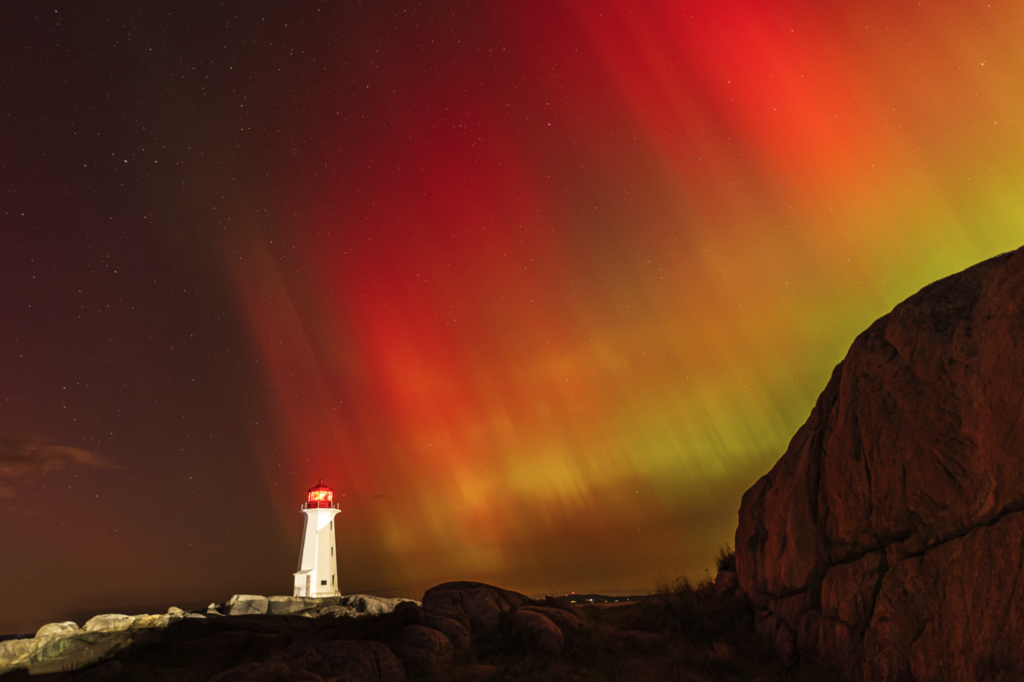
Guided in the Light – This shot of an incredible red aurora over Peggys Cove lighthouse was
taken on October 10, 2024 during the 2nd substorm of the night. We started shooting at the
Stargaze NS Observatory and were in awe of the 1st substorm. We went to Peggy’s Cove and
watch many people leave as the aurora faded, then minutes before packing up, the sky exploded
with color.
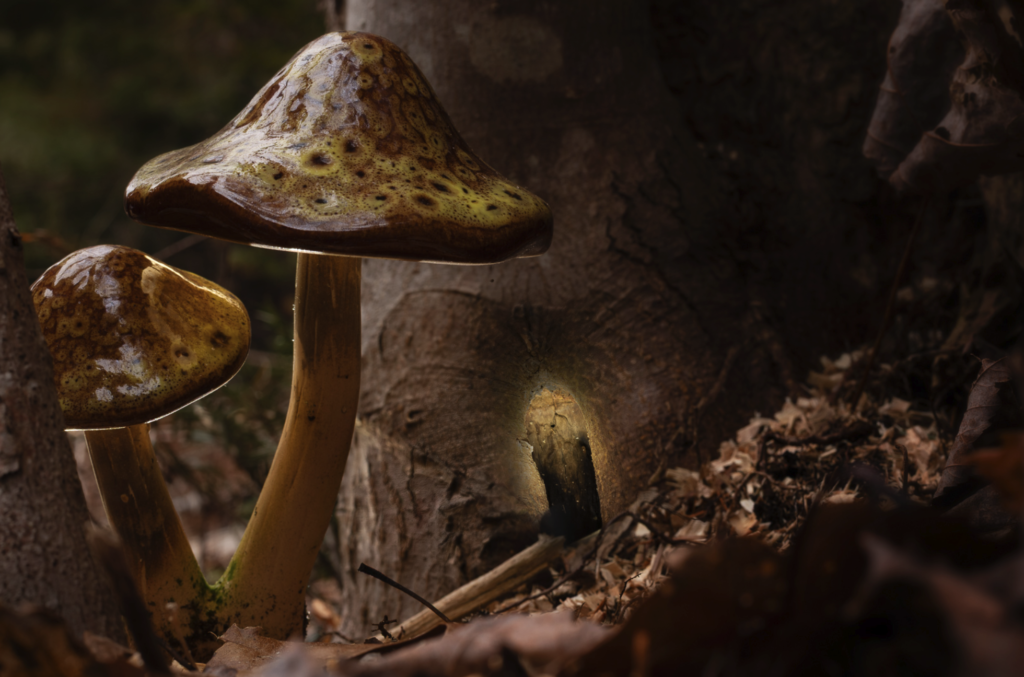
Hidden Beneath (Around the House) – This was a fun, staged shot in my backyard. I used
decorative mushrooms from a store along with 2 artificial lights. By lighting a hole at the base of
the tree and adding some rim light to the mushrooms, I hoped to create a surreal world hiding in
the forest.